• Abschlussquiz: Habe ich die Lernziele erreicht?

        Sie haben nun alle Module dieses Kurses durchlaufen. Im abschließenden Quiz können Sie noch einmal überprüfen, inwiefern Sie die zentralen Inhalte und Lernziele des Kurses erreicht haben. Nutzen Sie diese Gelegenheit, um Ihr Wissen zu reflektieren und die wichtigsten Konzepte rund um den Einsatz von KI im Fremdsprachenunterricht zu wiederholen.

      • Abschluss

        Platzhalter
        Aufgabe

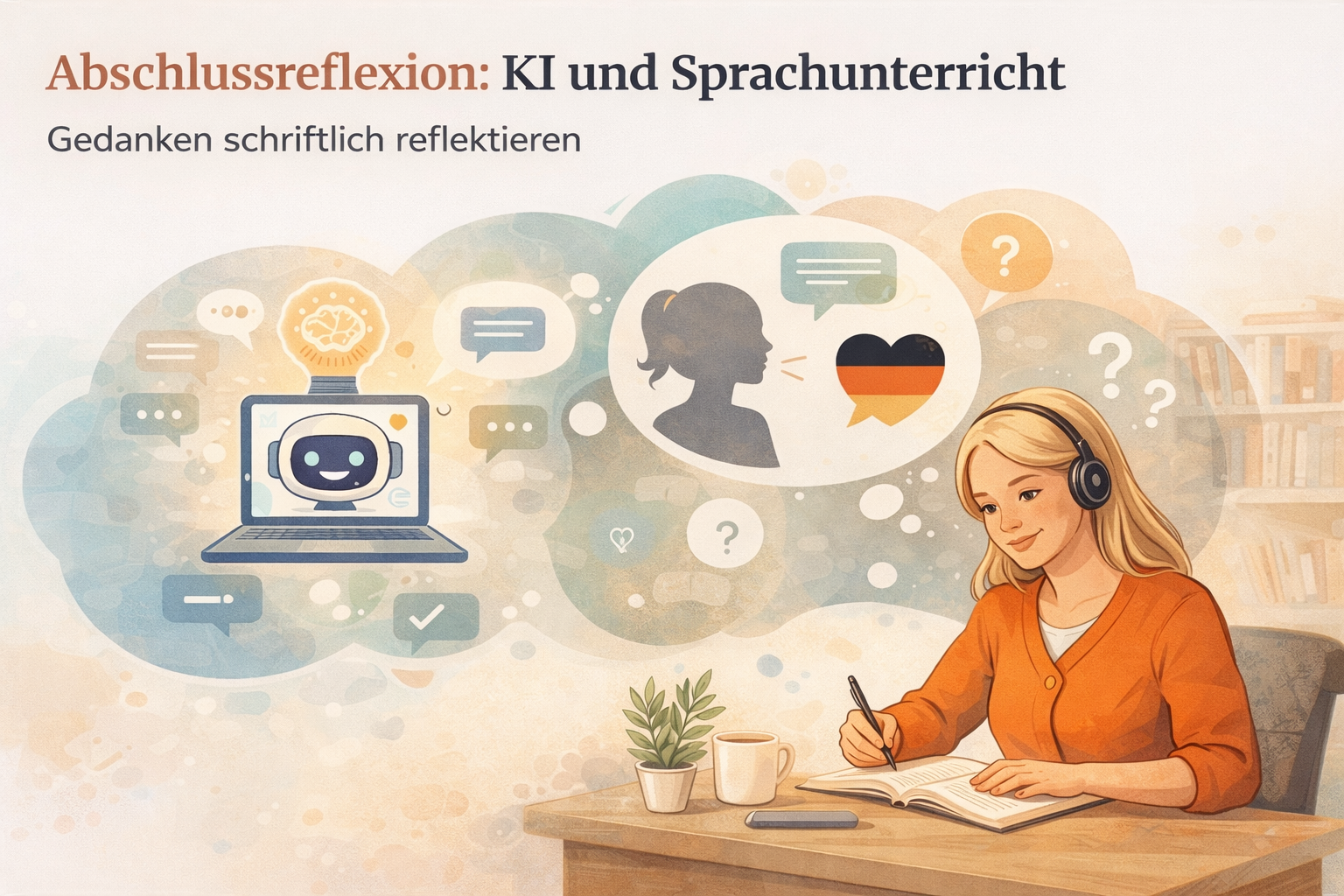
        Nehmen Sie sich 5–7 Minuten Zeit für ein fokussiertes Freewriting.

        Thema: "Wie verändert KI mein Verständnis von Sprachunterricht?"

        Schreiben Sie ohne Unterbrechung alles auf, was Ihnen dazu einfällt.
        Nicht korrigieren, nicht planen – einfach schreiben.

        Mögliche Impulse:

        • Welche Rolle sollte KI im Sprachunterricht spielen?

        • Was bleibt für mich unverzichtbar menschlich?

        • Welche Chancen sehe ich für Lernende?

        • Wo sehe ich Grenzen?

        Lesen Sie Ihr Freewriting anschließend noch einmal durch und markieren Sie zwei Gedanken, die Sie weiterverfolgen möchten.

        Ich hoffe, der Kurs hat Ihnen gefallen!

        Bei Fragen melden Sie sich gern per Mail bei mir: alinaliralorca@gmail.com 

      • Verwendete Quellen

        Ai, H. (2017). Providing graduated corrective feedback in an intelligent computer-assisted language learning environment. ReCALL, 29(3), 313–334. https://doi.org/10.1017/S095834401700012X

        Akpabio, E., Akpabio, I., & Akpabio, I. (2025). Leveraging AI for personalized English language learning: Tailoring instruction to individual needs. In Emerging Science Journal (pp. 385–415). IGI Global Scientific Publishing. https://doi.org/10.4018/979-8-3693-9077-1.ch015

        Alqaed, M. (2024). AI in English language learning: Saudi learners’ perspectives and usage. Advanced Education, (25). https://doi.org/10.20535/2410-8286.318972

        Berendt, B., Littlejohn, A., & Blakemore, M. (2020). AI in education: Learner choice and fundamental rights. Learning, Media and Technology, 45(3), 312–324. https://doi.org/10.1080/17439884.2020.1786399

        Canagarajah, A. S. (2011). Codemeshing in academic writing: Identifying teachable strategies of translanguaging. The Modern Language Journal, 95(3), 401–417.

        Chang, D. H., Lin, M. P.-C., Hajian, S., & Wang, Q. Q. (2023). Educational design principles of using AI chatbot that supports self-regulated learning in education: Goal setting, feedback, and personalization. Sustainability, 15(17), 12921. https://doi.org/10.3390/su151712921

        Crompton, H., Edmett, A., & Burke, D. (2024). Artificial intelligence and English language teaching: Affordances and challenges. British Journal of Educational Technology, 55(6), 2513–2538. https://doi.org/10.1111/bjet.13460

        Çobanoğulları, F., & Özbek, Ö. (2025). AI-powered language learning: Developing the ChatGPT usage scale for foreign language learners. Education and Information Technologieshttps://doi.org/10.1007/s10639-025-13342-w

        Dandu, G., Charyulu, G. M., & Lavanya Kumari, K. (2024). AI-driven language learning: The impact of Rosetta Stone on ESL students' speaking proficiency and self-control. Rupkatha Journal on Interdisciplinary Studies in Humanities, 16(4). https://doi.org/10.21659/rupkatha.v16n4.09

        Davoodifard, M., & Eskin, D. (2024). Exploring the role of generative AI in second language education: Insights for instruction, learning, and assessment. Studies in Applied Linguistics & TESOL, 24(1), 21–23.

        D’Esposito, M. E. W., & Gatner, S. (2024). Inteligência artificial no ensino-aprendizagem de línguas. Revista de Letras da USP, 45(3), 135–153. https://doi.org/10.23925/2318-7115.2024v45i3e63941

        DeKeyser, R. (2005). What makes learning second-language grammar difficult? A review of issues. Language Learning, 55(1), 1–25.

        Dorasamy, M., & Jambulingam, M. (2025). Generative AI and ChatGPT for foreign language learning: An action research. South Asian Journal of Management, 31(6), 97–119.

        Elbow, P. (1973). Writing without teachers. Oxford University Press.

        Elsherbiny, H., & Toumajian, D. (2025). From novelty to necessity: A survey on second language learning in the age of AI. The FLTMAG, 1–13.

        Ge, Z.-G., Zhang, A.-Y., Li, Y.-F., & Su, J. (2019). Exploring the impact of teachers’ verbal immediacy as an emotion mediating factor on adult e-learners’ language learning. Educational Technology & Society, 22(4), 77–89.

        Godwin-Jones, R. (2022). Partnering with AI: Intelligent writing assistance and instructed language learning. Language Learning & Technology, 26(2), 5–24.

        Hattie, J., & Timperley, H. (2007). The power of feedback. Review of Educational Research, 77(1), 81–112.

        Helmke, A., & Weinert, F. E. (1997). Bedingungsfaktoren schulischer Leistungen. In F. E. Weinert (Hrsg.), Psychologie des Unterrichts und der Schule (S. 71–177). Hogrefe.

        Krashen, S. (1985). The input hypothesis: Issues and implications. Longman.

        Kourkoulou, D., Tzirides, A.-O., Cope, B., & Kalantzis, M. (Hrsg.). (2024). Trust and inclusion in AI-mediated education: Where human learning meets learning machines. Springer. https://doi.org/10.1007/978-3-031-64487-0

        Kumar, P. C., Cotter, K., & Cabrera, L. Y. (2024). Taking responsibility for meaning and mattering: An agential realist approach to generative AI and literacy. Reading Research Quarterly, 59(4), 570–578. https://doi.org/10.1002/rrq.570

        Lee, H., & Lee, J. H. (2024). The effects of AI-guided individualized language learning: A meta-analysis. Language Learning & Technology, 28(2), 134–162.

        Meurers, D. (2020). Natural language processing and language learning. In C. A. Chapelle (Ed.), The concise encyclopedia of applied linguistics. Wiley.

        Pienemann, M. (1989). Is language teachable? Psycholinguistic experiments and hypotheses. Applied Linguistics, 10(1), 52–79.

        Schnotz, W., & Kürschner, C. (2007). A reconsideration of cognitive load theory. Educational Psychology Review, 19, 469–508.

        Shetye, S. (2024). An evaluation of Khanmigo, a generative AI tool, as a computer-assisted language learning app. Studies in Applied Linguistics & TESOL, 24(1), 38–53.

        Swain, M. (2005). The output hypothesis: Theory and research. In E. Hinkel (Ed.), Handbook of research in second language teaching and learning. Lawrence Erlbaum.

        Urquiza-Yllescas, J. F., Mendoza, S., Sánchez-Adame, L. M., Rodríguez, J., & Decouchant, D. (2024). Towards an architecture for educational chatbots. In Learning and Collaboration Technologies (HCII 2024). Springer.

        Vygotsky, L. S. (1986). Thought and language. MIT Press.

        Wang, X., Liu, Q., Pang, H., Tan, S. C., Lei, J., Wallace, M. P., & Li, L. (2023). Using chatbots as AI conversational partners in language learning. Computers & Education, 194, 104703.

        Zhi, R., & Wang, Y. (2024). On the relationship between EFL students' attitudes toward artificial intelligence, teachers' immediacy and teacher-student rapport, and their willingness to communicate. System, 124, 103341.

        Zhu, M., & Wang, C. (2025). A systematic review of artificial intelligence in language education: Current status and future implications. Language Learning & Technology, 29(1), 1–29.

        • Lizenzhinweis

          Dieser Kurs wurde von Alina Lira Lorca im Auftrag des Niedersächsischen Landesinstituts für schulische Qualitätsentwicklung (NLQ Hildesheim) erstellt und steht – soweit nicht anders gekennzeichnet – unter der Lizenz Creative Commons Namensnennung 4.0 International (CC BY 4.0).

          Lizenz:

          https://creativecommons.org/licenses/by/4.0/deed.de

          Als Namensnennung im Sinne der Lizenz ist vorgesehen:

          „Alina Lira Lorca im Auftrag des Niedersächsischen Landesinstituts für schulische Qualitätsentwicklung (NLQ Hildesheim), CC BY 4.0“.


          Bei Bearbeitungen oder Weiterentwicklungen ist kenntlich zu machen, dass Änderungen vorgenommen wurden.

          Materialien Dritter können abweichenden Lizenz- und Nutzungsbedingungen unterliegen und sind in diesem Fall gesondert gekennzeichnet.

          Redaktionell am 10.05.2026 bearbeitet von der AG "Digitale Lehr- und Lernszenarien", FB 53, NLQ.